
 By NewsAffair360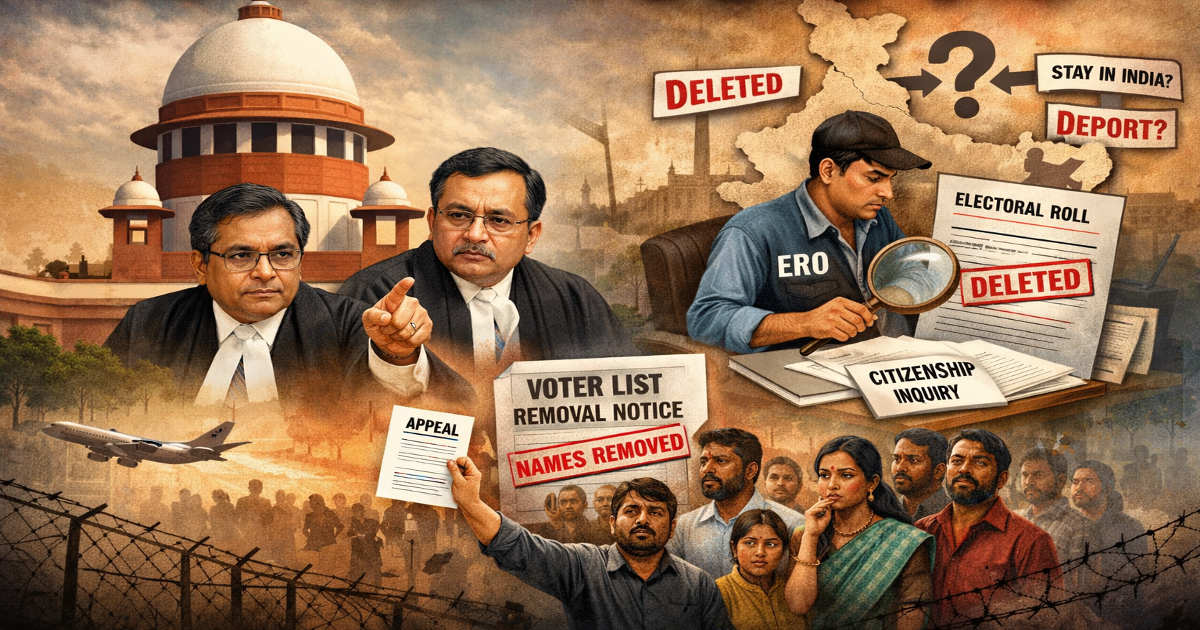
The Supreme Court of India has raised serious concerns over the Election Commission’s (EC) authority to remove names from electoral rolls based on inquiries into a person’s citizenship during the ongoing Special Intensive Revision (SIR) exercise. The Court asked whether such deletions could indirectly affect an individual’s right to remain in India, even before the Central government takes a final decision on citizenship.
Court’s Key Concern
A Division Bench led by Chief Justice Surya Kant and Justice Joymalya Bagchi questioned whether an Electoral Registration Officer (ERO) can strike a person’s name off the voters’ list after conducting an “inquisitorial” inquiry into citizenship, without waiting for the Central government to determine the person’s legal status under the Citizenship Act.
Justice Bagchi pointed out that once a person is removed from the electoral roll due to doubts about citizenship, it could potentially influence future actions by authorities, including investigations into whether the person should remain in India or be deported. The Bench asked whether such serious consequences should follow from an ERO’s decision alone.
Background: Massive Voter Deletions
The issue has gained national importance because draft electoral rolls published in nine States and three Union Territories — including West Bengal, Uttar Pradesh, and Tamil Nadu — reportedly saw the deletion of nearly 6.5 crore names during the second phase of the Special Intensive Revision.
These large-scale deletions triggered concerns about transparency, fairness, and the protection of citizens’ voting rights.
Election Commission’s Stand
Senior advocate Rakesh Dwivedi, appearing for the Election Commission, argued that:
- Article 326 of the Constitution,
- The Representation of the People Act, and
- The Registration of Electors Rules, 1960
together empower the EC and EROs to verify citizenship for the specific purpose of preparing accurate electoral rolls.
He maintained that the EC’s role is limited only to determining eligibility to vote, not to deciding deportation or residency rights.
According to him, even if an ERO finds a person is not a citizen, the final authority to decide whether that person can remain in India rests with the Central government.
Court’s Question on Timing
Justice Bagchi questioned whether a person’s voting right could be taken away before the Central government formally strips the individual of citizenship.
In response, Mr. Dwivedi said the ERO must take a decision “then and there.” Allowing a person whose citizenship is doubtful to remain on the electoral roll would undermine the integrity of elections.
He argued that while no system is perfect, the election process must aim for maximum accuracy, even if it means some errors are corrected later through legal remedies.
Safeguards for Affected Voters
The Election Commission clarified that:
- Any person excluded from the electoral roll has the right to appeal.
- If an ERO’s decision is found to be arbitrary or perverse, it can be overturned.
- The voter’s name can be restored after appeal.
Mr. Dwivedi emphasized that the entire electoral process cannot be stalled due to possible errors in individual cases, as the law already provides remedies.
Citizenship and Electoral Integrity
The EC counsel also stressed that citizenship and delimitation are the foundations of the electoral system. He cited examples from other laws, such as the Mines and Minerals (Development and Regulation) Act, which require authorities to verify citizenship before granting rights like mining leases. According to him, verifying citizenship is a normal and necessary administrative function.
Chief Justice Surya Kant summarized the EC’s argument by asking whether non-citizens are not entitled to vote — to which the EC counsel agreed, adding that an EC decision does not automatically lead to deportation.
Why This Case Matters
This case highlights the delicate balance between:
- Protecting the purity of electoral rolls, and
- Safeguarding the fundamental right to vote of genuine citizens.
The Court’s questions suggest that it wants clarity on whether administrative decisions during voter revision can indirectly affect a person’s citizenship status without due process by the Central government.
Current Affairs Key Points
- Supreme Court questioned EC’s power to delete voters based on citizenship inquiries.
- Nearly 6.5 crore names were removed during Special Intensive Revision in multiple States and UTs.
- Court asked whether ERO decisions could impact a person’s right to remain in India.
- EC argued it has constitutional and legal authority to verify citizenship for voter eligibility.
- EC clarified that deportation decisions lie only with the Central government.
- Affected voters have the right to appeal against deletion from electoral rolls.
- Case highlights the tension between electoral integrity and protection of civil rights.
You can also read this article in Telugu (తెలుగు).
Please stay connected with us for timely and trusted updates. NewsAffair360.