
 By NewsAffair360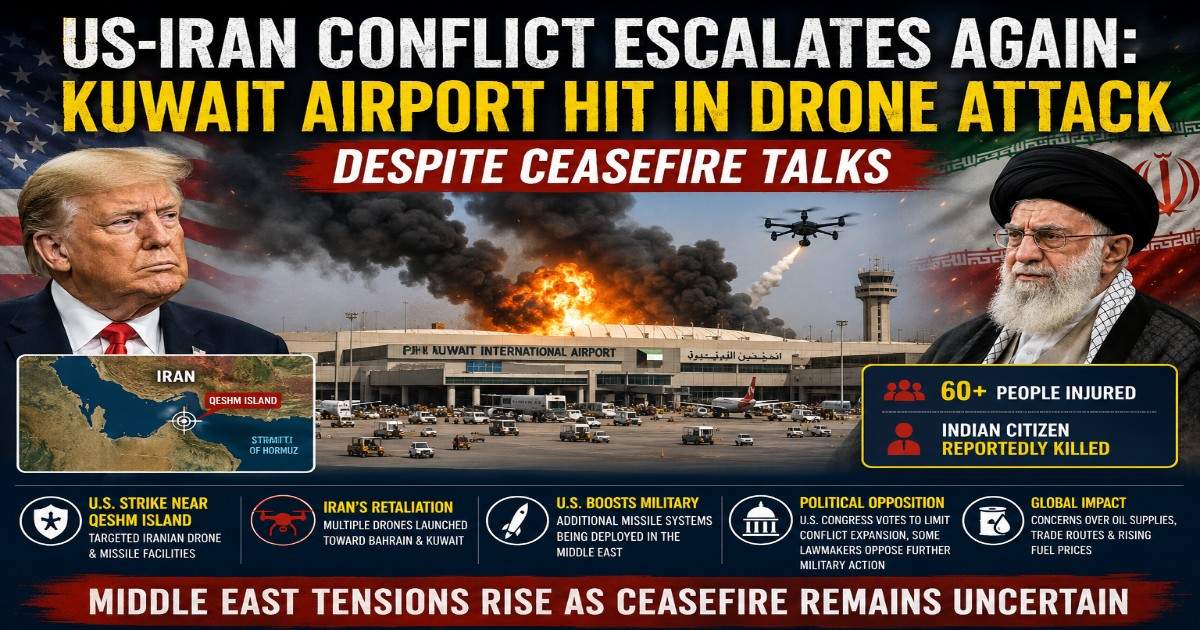
The US-Iran conflict has intensified after a reported Iranian drone strike hit Kuwait International Airport. The incident has raised concerns about ceasefire talks, regional stability, oil supplies, and the future of Middle East security.
The conflict between the United States and Iran appeared to be moving toward a period of calm after days of limited military activity and ongoing discussions about a possible ceasefire. Many observers believed that diplomatic efforts were gaining momentum and that both sides might be seeking ways to reduce tensions.
However, recent developments suggest that the ceasefire may exist only on paper. According to reports, Iran launched an attack that reached Kuwait International Airport, signaling that tensions in the Middle East remain high and that the risk of further escalation continues to grow.
The latest incident has raised concerns among governments, investors, and security experts worldwide, with fears that renewed hostilities could impact regional stability, global trade routes, and energy markets.
Fresh Escalation Begins Near Iran’s Qeshm Island
The latest escalation reportedly began following a United States military strike near Iran’s Qeshm Island. Located near the strategically important Strait of Hormuz, Qeshm Island is believed to host Iranian drone and missile facilities that play a significant role in the country’s defense infrastructure.
Why Did the United States Launch the Strike?
According to reports, the U.S. Central Command carried out strikes on June 3 against targets located on or near the island. American officials reportedly stated that the operation was conducted in self-defense, citing concerns that the facilities could potentially be used to launch future attacks against U.S. forces and regional allies.
The strike immediately increased tensions between Washington and Tehran, raising concerns that the conflict could enter a new phase.
Iran Responds With Drone Attacks
Iran reportedly viewed the U.S. operation as an act of aggression and responded by launching multiple drones toward targets in Bahrain and Kuwait.
Kuwait International Airport Reportedly Targeted
One of the drones allegedly struck Kuwait International Airport, resulting in a significant explosion that drew international attention. Reports indicate that more than 60 people were injured in the incident.
Tragically, reports also claim that an Indian citizen lost his life as a result of the explosion. Emergency services responded quickly to the scene, while authorities began assessing the extent of the damage.
International Concerns Over Civilian Infrastructure
Even if the attack was intended as retaliation, many observers argue that attacks on civilian infrastructure cannot be justified. The incident has renewed concerns regarding civilian safety and the potential consequences of military escalation in densely populated areas.
Security analysts warn that continued attacks on civilian facilities could further complicate diplomatic efforts and increase the risk of broader regional instability.
United States Strengthens Military Presence
Following the airport incident, the United States has reportedly increased its military preparedness across the Middle East.
Additional Missile Defense Systems Deployed
Reports suggest that Washington is moving additional missile defense systems into the region while strengthening military coordination with allies. The move is widely viewed as a precautionary measure against possible future attacks.
The increased military activity comes at a time when ceasefire discussions are still reportedly taking place, creating uncertainty about the future direction of the conflict.
Donald Trump’s Remark on Ceasefire Draws Attention
As tensions continued to rise, a reporter asked U.S. President Donald Trump about his view of a ceasefire in the Middle East.
Trump replied:
“Pretty much the way it is. It’s a different part of the world. I’d say in that part of the world, a ceasefire is when you’re shooting in a more moderate manner.”
The comment quickly attracted attention and sparked debate among political analysts and international observers regarding the effectiveness of ceasefire agreements in conflict zones.
Growing Political Opposition Inside the United States
The conflict is also becoming a subject of debate within American politics.
Lawmakers Push Back Against Further Escalation
On June 3, members of Congress reportedly voted on measures aimed at limiting any further expansion of military operations. Notably, some lawmakers from Trump’s own political camp were among those opposing deeper U.S. involvement.
The growing political divide reflects broader concerns about the long-term consequences of military engagement in the Middle East.
Impact on Global Economy and Oil Markets
The renewed tensions are not only affecting the Middle East but are also creating uncertainty in global financial markets.
Concerns Over Oil Supply and Trade Routes
Investors remain concerned about potential disruptions to oil supplies and international shipping routes, particularly around the Strait of Hormuz, one of the world’s most important energy corridors.
Any significant disruption in the region could impact global energy prices and increase transportation costs worldwide.
Rising Fuel Prices Become a Global Concern
As tensions rise, fuel prices have become a major concern for governments, businesses, and consumers. Central banks and policymakers are closely monitoring developments, as prolonged instability could contribute to inflationary pressures and slower economic growth.
Also Read: Israel and Lebanon Ceasefire Deal 2026: Hezbollah Withdrawal Key Condition for Peace
Key Points
- The US-Iran conflict appeared to be moving toward a ceasefire before fresh violence erupted.
- A reported U.S. strike near Iran’s Qeshm Island triggered a new escalation.
- Iran reportedly launched drones toward Bahrain and Kuwait in response.
- One drone allegedly struck Kuwait International Airport, causing a major explosion.
- More than 60 people were reportedly injured.
- Reports claim that an Indian citizen lost his life in the incident.
- The United States has reportedly increased military readiness across the Middle East.
- Donald Trump’s comments on ceasefire negotiations have gained international attention.
- Political opposition to expanded military action is growing within the United States.
- Global markets are concerned about oil supplies, trade routes, and rising fuel prices.
You can also read this article in Telugu (తెలుగు).
The latest developments highlight the fragile nature of ceasefire efforts between the United States and Iran. The reported drone strike on Kuwait International Airport has once again demonstrated how quickly tensions can escalate despite ongoing diplomatic discussions.
As military preparations increase and political debates intensify, the international community continues to monitor the situation closely. The coming days may prove crucial in determining whether the region moves toward renewed negotiations or faces a deeper and more dangerous phase of conflict.
For now, uncertainty remains high, and the impact of the ongoing tensions is being felt far beyond the Middle East, affecting global markets, energy security, and international stability.
Please stay connected with us for timely and trusted updates. NewsAffair360.