
 NewsAffair360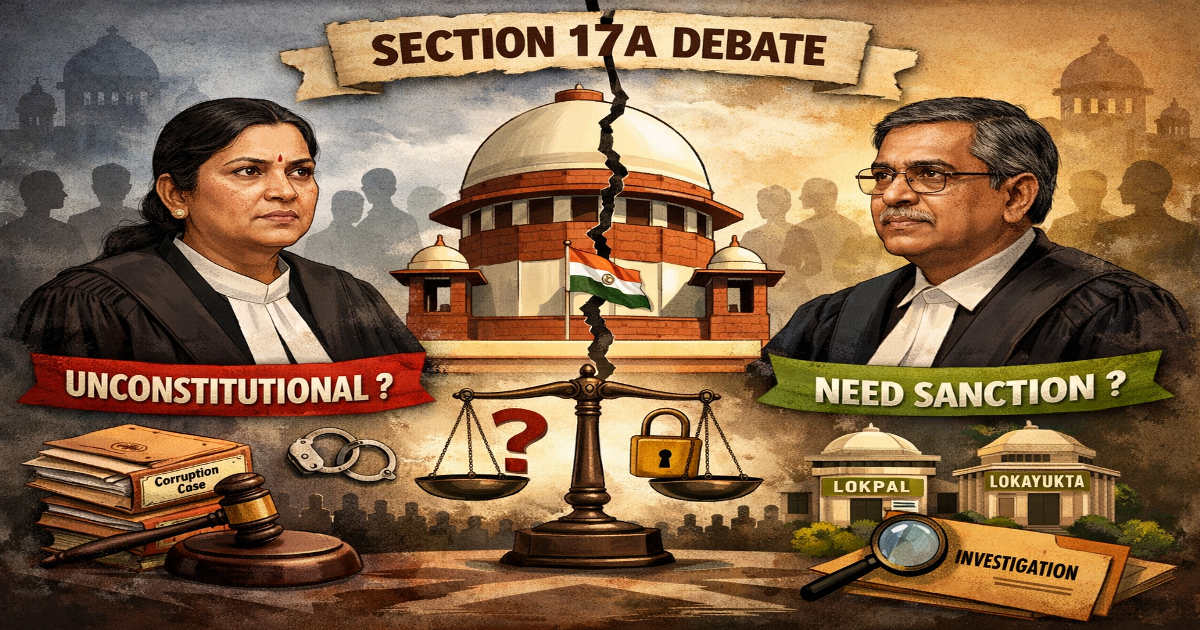
The Supreme Court of India has delivered a split verdict on the constitutional validity of Section 17A of the Prevention of Corruption Act, 1988, a provision that requires prior government approval before initiating an investigation against public servants for decisions taken in official capacity.
The Division Bench, consisting of Justice B.V. Nagarathna and Justice K.V. Viswanathan, expressed sharply contrasting views on whether the provision protects honest officers or undermines accountability.
As the judges differed in opinion, the matter will now be referred to the Chief Justice of India, who will assign it to a three-judge Bench for a final decision.
What is Section 17A?
Section 17A was introduced through the 2018 amendment to the Prevention of Corruption Act. It mandates prior sanction from a competent authority before any inquiry, investigation, or prosecution of a public servant for decisions taken while performing official duties.
The objective was to protect officials from frivolous or motivated complaints, especially in policy decision-making.
Justice K.V. Viswanathan’s View: Sanction is Necessary, But Must Be Independent
Justice Viswanathan upheld the validity of Section 17A, but emphasized that the sanction must be granted by an independent authority such as:
He warned that striking down the provision completely would expose public servants to unnecessary harassment.
Key Observations:
- The possibility of misuse cannot be a reason to declare a law unconstitutional.
- Removing sanction protection would encourage frivolous FIRs and coercive investigations.
- Honest officers would become overly cautious, leading to policy paralysis.
- He famously remarked that striking down Section 17A would be like “throwing the baby out with the bathwater.”
Justice Viswanathan stressed that an independent preliminary inquiry should ideally take place before sanction is granted.
He also highlighted that even the Prime Minister can be investigated by the Lokpal, proving that accountability mechanisms already exist.
According to him, eliminating prior approval entirely would be a regressive step, allowing immediate investigations even on weak, motivated, or hindsight-based allegations.
Justice B.V. Nagarathna’s View: Section 17A is Unconstitutional
Justice Nagarathna took a completely opposite stand, declaring Section 17A unconstitutional.
She ruled that the provision violates Article 14 of the Constitution, which guarantees equality before law.
Her Key Arguments:
- Section 17A gives special protection only to higher-ranking public servants, creating an unequal classification.
- The nature of duties cannot justify denying basic investigation into corruption allegations.
- The provision prevents even a preliminary inquiry without prior approval, which is against the rule of law.
- Protecting “honest officers” cannot be a valid justification to block early scrutiny in corruption cases.
Justice Nagarathna concluded that Section 17A defeats the very purpose of anti-corruption legislation and weakens public accountability.
The Core Conflict: Protection vs Accountability
Both judges agreed that a balance is essential, but differed on how to achieve it:
- Justice Viswanathan prioritised protection from malicious prosecution.
- Justice Nagarathna prioritised equality before law and transparency.
The final verdict will now depend on a larger Bench, which will decide whether Section 17A should be:
- Struck down completely,
- Upheld fully, or
- Modified with safeguards.
Why This Judgment Matters
This case has major implications for:
- Anti-corruption investigations
- Bureaucratic accountability
- Governance reforms
- Public trust in institutions
The decision will shape how corruption cases against senior officials are handled in future.
Current Affairs Key Points
- Supreme Court delivered a split verdict on Section 17A of the Prevention of Corruption Act.
- Justice B.V. Nagarathna declared Section 17A unconstitutional under Article 14.
- Justice K.V. Viswanathan upheld the provision but called for independent sanction authorities.
- Section 17A requires prior approval before investigating public servants for official decisions.
- Matter referred to the Chief Justice of India for a three-judge Bench.
- Debate centers on protection of honest officers vs accountability for corruption.
- Lokpal and Lokayukta recognized as independent bodies for sanction decisions.
- Final judgment will impact future corruption investigations in India.
You can also read this article in Telugu (తెలుగు).
Please stay connected with us for timely and trusted updates. NewsAffair360.